4.0 Managing Georgia's Waters
The characteristics of water resources and water users vary significantly across the state. Meeting future water needs requires regional water plans that fit the resources and users in each region.
Through the regional water planning process, people who live and work in each region of the state identified actions, referred to as management practices, necessary to meet current and future water needs. Each Council selected actions based on the results of the forecasts and water resource assessments, described in Sections 2 and 3, as well as their vision and goals for their region’s water future.
Management practices will primarily be implemented by local governments, utilities, and other water users who develop infrastructure and apply for permits, grants or loans. The plans provide flexibility, allowing implementers to select from the actions listed in each plan to effectively address local conditions and needs.
This section provides a high-level overview of the practices in each plan. Much more information can be found in the plans themselves, including priorities, implementation responsibilities, sequencing, and information needs. The plans can be downloaded from www.georgiawaterplanning.org or requested by contacting EPD
4.1 Water Conservation Management Practices (lists)
The goal of water conservation is to maximize the benefit from each gallon of water used, helping to ensure that available supply can meet future needs. Georgia’s State Water Plan recognizes water conservation as a priority water management practice to be implemented by all water use sectors to help meet needs across the state.
The water conservation practices in each regional water plan are summarized in this figure. Categories were chosen to show the range of practices in each plan, with symbols indicating the sectors or types of water use addressed.
The conservation practices in each plan are based on the condition of the region’s water resources, specifics of water use within that region, and the extent that conservation is currently being implemented. The plans generally assume that the more limited a region’s water resources, the greater the justification for investments in water conservation.
All plans outline voluntary water conservation practices to be implemented by the region’s major water users. Practices for municipal and industrial users include water audits, leak reduction, schedules for outdoor watering, and use of more efficient fixtures and processes. For the agricultural sector, practices include steps to improve information on water use and efficiency as well as incentives for implementation of advanced conservation practices. Public education is an important element of each plan.
Some plans specify mandatory conservation practices to be implemented by water users in areas with high demand or significant shortfalls in water availability. Some plans also identify benchmarks for achieving performance-based indicators of efficient water use.
Each plan underscores the importance of better information on water use by different sectors. Management practices include actions to help us better understand current levels of water conservation and to document progress toward greater water use efficiency.
Many plans are also supplemented by a technical memorandum documenting the methods used to determine appropriate conservation practices, cost of implementation and potential water savings in the region. Technical memoranda can be downloaded from www.georgiawaterplanning.org or requested by contacting EPD.
Practices by Region
See the regional water plans for details on management practices, including priorities and implementation steps.
Coosa - North Georgia
- Municipal Outdoor
- Municipal Indoor
- Agricultural Practices
- Industry
- Education/Outreach
- Reuse
- Golf Courses
Metro Water District
- Municipal Outdoor
- Municipal Indoor
- Industry
- Education/Outreach
- Reuse
- Golf Courses
- Energy
Middle Chattahoochee
- Municipal Outdoor
- Municipal Indoor
- Agricultural Practices
- Industry
- Education/Outreach
Upper Flint
- Municipal Outdoor
- Municipal Indoor
- Agricultural Practices
- Industry
- Education/Outreach
Lower Flint - Ochlockonee
- Municipal Outdoor
- Municipal Indoor
- Agricultural Practices
- Industry
- Education/Outreach
Savannah - Upper Ogeechee
- Municipal Outdoor
- Municipal Indoor
- Agricultural Practices
- Industry
- Education/Outreach
- Reuse
- Golf Courses
- Energy
Upper Oconee
- Municipal Outdoor
- Municipal Indoor
- Agricultural Practices
- Industry
- Education/Outreach
- Reuse
- Golf Courses
Middle Ocmulgee
- Municipal Outdoor
- Municipal Indoor
- Agricultural Practices
- Industry
- Education/Outreach
- Reuse
- Golf Courses
- Energy
Altamaha
- Municipal Outdoor
- Municipal Indoor
- Agricultural Practices
- Education/Outreach
Suwannee - Satilla
- Municipal Outdoor
- Municipal Indoor
- Agricultural Practices
- Education/Outreach
Coastal
- Municipal Outdoor
- Municipal Indoor
- Agricultural Practices
- Industry
- Education/Outreach
- Reuse
- Golf Courses
- Energy
4.1 Water Conservation Management Practices (table)
The goal of water conservation is to maximize the benefit from each gallon of water used, helping to ensure that available supply can meet future needs. Georgia’s State Water Plan recognizes water conservation as a priority water management practice to be implemented by all water use sectors to help meet needs across the state.
The water conservation practices in each regional water plan are summarized in this figure. Categories were chosen to show the range of practices in each plan, with symbols indicating the sectors or types of water use addressed.
The conservation practices in each plan are based on the condition of the region’s water resources, specifics of water use within that region, and the extent that conservation is currently being implemented. The plans generally assume that the more limited a region’s water resources, the greater the justification for investments in water conservation.
All plans outline voluntary water conservation practices to be implemented by the region’s major water users. Practices for municipal and industrial users include water audits, leak reduction, schedules for outdoor watering, and use of more efficient fixtures and processes. For the agricultural sector, practices include steps to improve information on water use and efficiency as well as incentives for implementation of advanced conservation practices. Public education is an important element of each plan.
Some plans specify mandatory conservation practices to be implemented by water users in areas with high demand or significant shortfalls in water availability. Some plans also identify benchmarks for achieving performance-based indicators of efficient water use.
Each plan underscores the importance of better information on water use by different sectors. Management practices include actions to help us better understand current levels of water conservation and to document progress toward greater water use efficiency.
Many plans are also supplemented by a technical memorandum documenting the methods used to determine appropriate conservation practices, cost of implementation and potential water savings in the region. Technical memoranda can be downloaded from www.georgiawaterplanning.org or requested by contacting EPD.
Practices by Region
See the regional water plans for details on management practices, including priorities and implementation steps.
| Regions | Municipal Outdoor | Municipal Indoor | Agricult-ural Practices | Industry | Education/ Outreach | Reuse | Golf Courses | Energy |
|---|---|---|---|---|---|---|---|---|
| Coosa - North Georgia | X | X | X | X | X | X | X | |
| Metro Water District | X | X | X | X | X | X | X | |
| Middle Chatta-hoochee | X | X | X | X | X | |||
| Upper Flint | X | X | X | X | X | |||
| Lower Flint - Ochlock-onee | X | X | X | X | X | |||
| Savannah - Upper Ogeechee | X | X | X | X | X | X | X | X |
| Upper Oconee | X | X | X | X | X | X | X | |
| Middle Ocmulgee | X | X | X | X | X | X | X | X |
| Altamaha | X | X | X | X | ||||
| Suwannee - Satilla | X | X | X | X | ||||
| Coastal | X | X | X | X | X | X | X | X |
4.4 Regional Management Practices
4.4.1 Coosa-North Georgia, Metro Water District
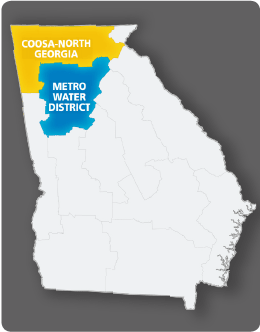
The Metropolitan North Georgia Water Planning District was created in 2001 to serve as the water planning entity for the greater Atlanta metropolitan area. The Metro District covers 15 counties and 91 cities. Employment in this region is dominated by trade, transportation and utilities, professional and business services, and government. Major water resources include the Chattahoochee and Coosa rivers, some of their tributaries, and lakes Allatoona and Lanier.
The categories and practices shown here were selected to illustrate the water management approaches taken in each region, but they do not reflect all of the practices in either plan. The regional water plans themselves should be consulted for detailed descriptions of the full suite of management practices.
Coosa-North Georgia
In 2005, 92% of the water used in this region came from surface water and 8% from groundwater. The 2010 forecast showed water use in the following sectors: 78% for energy, 15% for municipal users, 5% for industry, and 2% for agriculture.
The Coosa-North Georgia plan presents 42 management practices to address issues related to population growth and land use changes. The plan also focuses on the importance of conservation and water supply.
Water Conservation
Focus on residential, agricultural, and governmental sectors. Provide public education and implement water conservation practices now required by state law.
Water Supply
Develop water master plans first, then expand existing and construct new reservoirs as needed. Encourage new groundwater wells, reuse, and better management of water treatment systems.
Wastewater and Water Quality
Wastewater practices focus on local master plans, public education, septic system management and sewer system maintenance and operation. Water quality practices target nutrient management, erosion and sediment control, stormwater from urban and forestry land, stream buffers and floodplain management, water quality credit trading and addressing waters that don’t meet standards.
Information Needs
Refine resource models and improve assumptions about land application systems; study water quality effects of septic systems; obtain better information on agriculture water use, including future demand for golf courses and animal operations.
Recommendations to State
Identify long term funding and implementation mechanisms to support regional planning. Develop guidelines for water quality credit trading, interbasin transfers, and aquifer storage and recovery. Explore the Tennessee River as a water source and support regional reservoir projects.
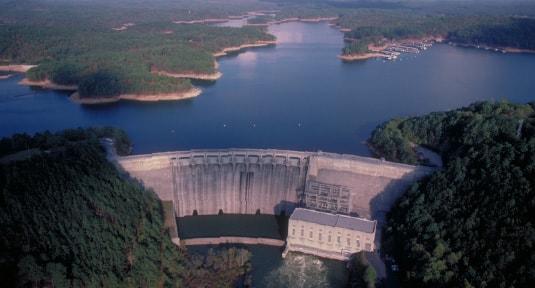
Photo credit: Georgia Department of Economic Development
Photo caption: Allatoona Dam, Coosa Basin
Metro Water District
In 2006, 99% of the water used in the District came from surface water and 1% from groundwater. The 2010 forecast showed water use by the following sectors: 39% for energy, 54% for municipal users, 2% for industry, and 3% for agriculture.
The legislation that created the District requires three plans for the metro Atlanta area: a water supply and conservation plan, a wastewater management plan, and a watershed management plan. Since adoption of the State Water Plan, the District works within the statewide framework of regional
planning, completing current plans in 2009. The District plans present a wide array of management practices, and local governments and some other entities in the District are subject to audits to ensure compliance before water permits, state grants, or state loans are given.
Water Conservation
Practices are very aggressive, including conservation pricing, plumbing retrofits, rain sensors, sub-metering, assessing and reducing leakage, residential and commercial water audits, car wash water recycling, and public education.
Water Supply
Implement planned facilities, including expansion of existing treatment plants as well as construction of new reservoirs and treatment plants. Reuse, local water planning, and education are also included.
Wastewater and Water Quality
Construct, expand, upgrade or retire specific wastewater facilities; inspect, maintain and rehabilitate wastewater systems; enhance septic system management and education. Water quality practices address watershed planning; alternative ways to develop land; maintenance of sewer pipes, ponds and other structures; pollution prevention; and education.
Information Needs
Research restricting sale of certain fertilizers; update the Georgia Stormwater Management Manual; evaluate and compile watershed monitoring data; and assess viability of a web-based electronic data management center.
Recommendations to State
Streamline water permitting and reporting; consider incentives and financial support; coordinate land use planning and water planning; ensure water supply buffers are adopted and enforced; track septic system installation and revise maintenance requirements; enhance septic limitations in critical areas and enforcement of laws for septic systems; meet stormwater criteria for road designs and implement transportation capital improvements to address runoff.