5.0 A State-wide Effort

Georgia's continued prosperity and quality of life are tied to how we collectively manage our water resources.
As the state’s population and economy grow, demands on the state’s waters grow as well. Over the past several decades, decisions about water management in Georgia were made largely in response to specific issues or needs. Meeting future water challenges will require a more proactive, comprehensive, and cooperative approach.
To that end, Georgia’s 2008 State Water Plan calls for on-going water planning that incorporates local and regional perspectives to ensure that the state’s water resources are sustainably managed.
In February of 2009, the Governor, Lieutenant Governor, and Speaker of the House appointed the 300 members of the ten new Water Planning Councils. The Councils spent the next two and a half years learning about their region’s water resources, developing a regional vision and goals, refining assessments and forecasts, and identifying strategies for water management. Using this information and working with a range of stakeholders including neighboring Councils, the Councils prepared the plans described in this document.
With the plans already completed by the Metro District, Georgia now has a state-wide base of regional water plans that build on local and regional perspectives to identify the most appropriate ways to meet water needs through 2050.
Photo credit: Georgia Department of Economic Development
Photo caption: Coastal Boating, Coastal Georgia
5.1 A Decade of Water Planning in Georgia
With completion of the regional water plans, Georgia is ready to embark on its second decade of strategic water resource planning. This timeline shows major milestones to date in Georgia’s statewide and regional water planning.
2001: Metropolitan North Georgia Water Planning Act was passed, creating the Metropolitan North Georgia Water Planning District (Metro Water District)
2003: Metro Water District prepared and adopted three regional water plans: Watershed Management Plan, Long-term Wastewater Management Plan, and Water Supply and Water Conservation Management Plan
2004: Georgia’s Comprehensive State-wide Water Planning Act was passed, directing EPD and the Water Council to prepare Georgia’s Comprehensive State-wide Water Management Plan (State Water Plan)
2008: The State Water Plan was adopted by the General Assembly, establishing a framework for regional water planning
March 2009: Kick-off of regional water planning under the State Water Plan. Water Planning Councils begin meeting at least quarterly Regional Water Planning Rules adopted by Board of Natural Resources
May 2009: The Metro Water District revised their plans
July 2009: EPD issued Regional Water Planning Guidance
January 2010: EPD released initial results from assessments of groundwater availability, surface water availability, and surface water quality
March 2010: EPD released the Water Conservation Implementation Plan
September 2011: Regional Water Plans adopted
5.2 The Water Planning Process
The State Water Plan established innovative approaches to water management in Georgia. An ongoing process for regional water planning is central to this effort.
This figure depicts Georgia’s comprehensive water planning cycle. The approach emphasizes flexibility, allowing state agencies, Water Planning Councils, water users, and others to adapt as new circumstances and information arise. The approach ensures that regional differences, as reflected in water needs and the condition of regional water resources, are integral considerations in management decisions.
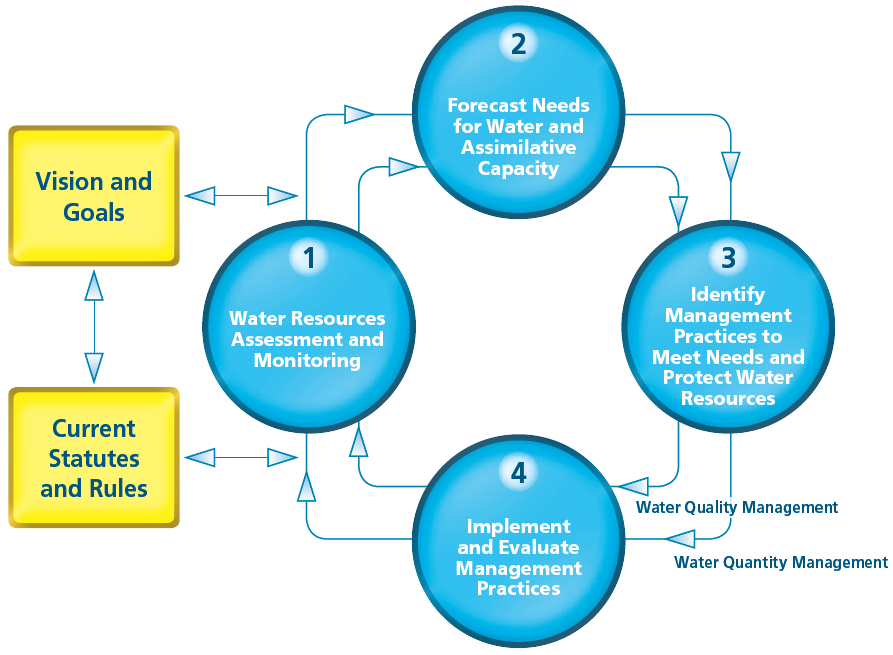
Both Water Quality Management and Water Quantity Management flow through this process from start to finish, then back to the beginning.
- Water Resources Assessment and Monitoring
- Forecast Needs for Water and Assimilative Capacity
- Identify Management Practices to Meet Needs and Protect Water Resources
- Implement and Evaluate Management Practices
Throughout the cycle, the Water Planning Councils' Vision and Goals and the Current Statutes and Rules persist.
Over the past three years, the Water Planning Councils, the Environmental Protection Division, and other state agencies have put this cycle in motion, helping Georgia take an important step forward in water management. The Councils’ have considered information on the condition of water resources in their region (Item #1 above) along with information on the anticipated water needs (Item #2 above). They then identified actions that, when implemented, will help ensure that each region’s water resources can sustainably meet water needs, now and in the future (Item #3 above). Each Council’s vision and goals for their regional water future served a frame of reference as they prepared their recommendations.
The next steps are to implement the regional water plans and evaluate the effect of the practices that are put in place. And, as the regional water plans recognize, it will be important that we continue to improve information on water needs and the condition Georgia’s water resources. This information will be the starting point for a renewed look at regional water plans in 2016 when, as the State Water Plan requires, Water Planning Councils will review their plans and revise them as needed.
5.5 Water Planning Councils and Members
Appointed based on the guidelines of the State Water Plan, 2008
Altamaha
- Gary Bell
- Randy Branch (Alt.)
- Guy R. Bullock
- James M. Burns
- Gerald A. DeWitt (Alt.)
- Will Donaldson, Jr.
- Cleve Edenfield
- Jim Free
- Randy Giddens
- Len Hauss
- Edward S. Jeffords, Vice Chair
- Phillip Jennings
- L. Brinson Lanier, Chair
- Dan McCranie
- Steve Meeks
- Buddy Pittman
- Michael A. Polsky, Vice Chair
- John E. Roller
- Sue B. Sammons
- Doug Sharp
- Paul A. Stavriotis (Alt.)
- James E. Strickland
- Dent L. Temples
- Lindsay Thomas
- William G. Tomberlin
- Michael Williams
- Russ Yeomons
- Representative Greg Morris, Ex-Officio
- Senator Tommie Williams, Ex-Officio