1.0 Executive Summary
Georgia’s quality of life and economic prosperity are vitally linked to the sustainable management of our water resources.
Georgia has long been one of the fastest growing states in the nation. Between 2000 and 2010, Georgia gained 1.5 million new residents, ranking 4th nationally. Georgia is home to over 40 Fortune 1000 companies and over 2,500 internationally headquartered facilities with an estimated capital investment of $24 billion. Our agricultural industry employs over 350,000 people and has an economic impact of almost $70 billion.
Georgia enjoys abundant water resources, with 14 major river systems and seven highly productive groundwater aquifers. These resources are shared by many users, supporting a wide array of natural systems and human activities.
Although water in Georgia is plentiful, it must be carefully managed to meet the needs of a variety of users. Water plans have been developed for Georgia’s eleven water planning regions to help ensure that our water resources continue to support the state’s economy and natural systems. The plans outline near-term and long-term strategies to meet water needs through 2050.
Regional water planning has helped Georgia take meaningful strides forward in water management. Plans were developed from the bottom up, with solutions identified by a cross-section of regional leaders. They are fact-based, building on scientific observations and information from people who live and work in each region. Recognizing that blanket solutions will not meet our water challenges, the plans emphasize local and regional action with the flexibility to adapt to changing circumstances.
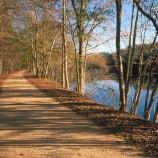
Photo credit: Georgia Department of Economic Development
Photo caption: Augusta Canal, Savannah Basin
River Basins in Georgia
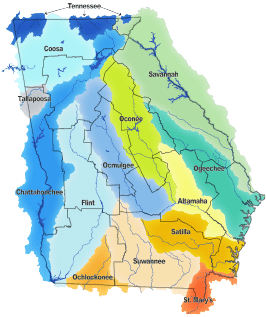
Aquifers in Georgia
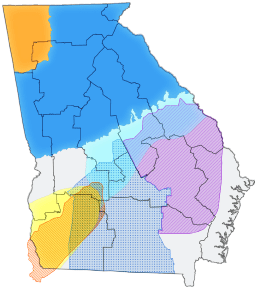
Aquifer Legend


1.1 Introduction
This report presents highlights of regional water planning conducted from 2009 to 2011, following the 2008 adoption of Georgia’s State Water Plan. The State Water Plan established ten new Water Planning Councils that, with the Metropolitan North Georgia Water Planning District, have now completed plans for the state’s 11 water planning regions.
In the three years since adoption of the State Water Plan, over 30,000 volunteer hours have been contributed and the State has invested $30 million in technical work and activities to support regional water planning. The Councils and District have developed regional water plans that together provide a roadmap for sustainable use of the Georgia’s water resources. Local governments, utilities, industries, and other water users in each region will implement the plans, and plan contents will help guide state agency decisions on water permits and grants and loans for water-related projects.
To prepare this report, we selected highlights from the eleven regional water plans. The full plans contain more in-depth information and should be consulted for details. The water plan for your region(s) can be downloaded from www. georgiawaterplanning.org or requested by contacting the Environmental Protection Division.
This report has four main sections, each addressing a different component of regional water planning. Sections 2 and 3 describe forecasts of water needs and the capacities of Georgia’s water resources. Section 4 provides an overview of the water management approaches presented in each regional plan. The final section outlines Georgia’s water planning process and steps following adoption of the regional water plans.
1.2 Improving Information and Understanding Issues
Homes, schools, businesses, and farms all require water, and the wastewater generated by some water uses has to be safely discharged. Understanding the demands on our water resources is a critical first step in managing Georgia’s waters for the future. Forecasts of water and wastewater demand were prepared to support regional water planning, providing this information on a consistent, statewide basis for the first time.
Understanding the capacities of water resources to meet the demands placed on them is also critical to managing water for the future. Over the past three years, EPD led the development of groundwater sustainability models for the most-heavily used aquifers in the state, surface water availability models for the state’s major river basins, and water quality models for many streams and most of the large lakes in the state.
Building on prior investments in monitoring and assessment of Georgia’s waters, this technical work filled critical information gaps. Results were tested against the knowledge of the Council members who live and work in each region, providing feedback used to refine the tools. The Councils and other participants also identified additional improvements to enhance the models for future use.
Results of these assessments show that, in most regions, additional groundwater is available to meet current and future groundwater needs. Two areas do face limitations on the availability of groundwater. The first is Southwest Georgia, where demand for groundwater exceeds the amount that can be sustainably withdrawn from the region’s principal aquifer. The second area lies along the coast, where groundwater availability is limited by movement of saltwater into the principal aquifer. In these areas, additional demand for water will have to be met from surface water or from other aquifers.
For surface waters, results indicate that much of the state has sufficient water to meet future demands. In river basins with large reservoirs, existing surface water storage could help meet future needs if agreements allowing that use can be made with reservoir owners (U.S. Army Corps of Engineers and power companies).
In some other river basins, however, there may not be enough water during dry periods to meet demands for water and have stream flows above minimum thresholds. These results provide a warning that water consumption may impact uses that rely on water within the banks of streams, rivers, and lakes, such as boating and recreation. As described in Section 4, actions to increase water conservation and water supply will be particularly important in these areas.
Most of the surface waters we studied will be able to handle additional discharges of treated wastewater. Some dischargers, however, may have to provide higher levels of wastewater treatment in order to protect water quality.
In all water planning regions, assessments identified water bodies that currently have poor water quality, often due to the pollutants carried by stormwater. Results also identify areas where pollutants carried in stormwater runoff may cause water quality problems in the future. Actions are needed to protect or restore the water quality in these streams, rivers, lakes, and estuaries.
Finally, the regional water plans highlight issues specific to individual regions. Examples include operation of federal reservoirs, protection of recreational uses on lakes, wastewater discharges in waters shared with neighboring states, and water quality issues associated with low levels of dissolved oxygen. Where applicable, the plans recognize the complementary activities that are underway to address these issues.
1.3 Meeting Georgia’s Water Resource Challenges
The Water Planning Councils spent almost three years examining and refining technical information about water resources and water use, comparing that information to visions and goals for their region, and identifying strategies for management. What has emerged are a set of practical approaches – customized for each region – to support continued growth and prosperity statewide while maintaining healthy natural systems.
The regional water plans identify a range of actions or management practices to help meet the state’s water challenges. In regions facing challenges with availability of surface water and groundwater, the plans recommend actions such as increasing water conservation and efficiency of use, master planning for local water systems, expanding or optimizing use of existing reservoirs, constructing new reservoirs where needed and feasible, and shifting to alternative sources of water.
To address water quality challenges, some or all of the plans call for higher levels of wastewater treatment, master planning for local wastewater systems, improved floodplain management, and stream buffer protection, among other actions. The plans also identify strategies to address water quality problems that result from stormwater carrying pollutants into water bodies, including a funded nonpoint source management project in each region.
Implementing these plans is critical to meeting Georgia’s water resource challenges. Local governments and others who develop water infrastructure and apply for permits, grants, and loans have a central role in plan implementation. State government also has an important role in supporting implementation. And, as emphasized in the plans, the success of implementation will rest, in large part, upon funding at state and local levels.
Continuing to improve data and information will also be important in meeting our water resource challenges. Over the past few years, the State made substantial investments in modeling tools and monitoring networks. However, information gaps and uncertainties still affected the Councils’ ability to plan. The regional water plans all include specific actions necessary to improve the tools and information used in water planning and management.
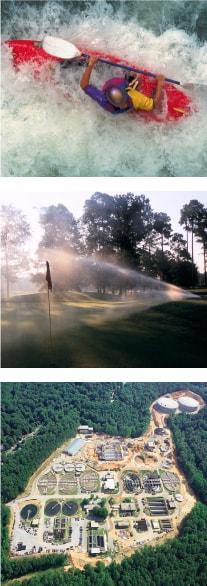
Finally, the regional water plans recognize the activities underway to promote water conservation, improve operations of federal reservoirs, address water quality in waters shared with other states, resolve interstate disputes over water supply, and meet a number of other region-specific challenges. The strategies in the plans reflect these complementary activities and will be implemented in concert with them.
In summary, the regional water plans are not themselves an end. The plans present solutions identified by a cross-section of regional leaders, drawing on regional knowledge and priorities. They are based on consistent, statewide forecasts of needs and reflect the best available information on the capacities of Georgia’s waters. The tools used to assess the capacities have been tested and refined, and will be further refined as we continue to improve information for planning and management. The process and results of regional planning, taken together, provide solid footing for plan implementation and the five-year review and revision required by the State Water Plan.
The investment in these assets will continue to pay off over time, advancing management of Georgia’s waters to support the state’s economy, protect public health and natural systems, and enhance the quality of life for all citizens.
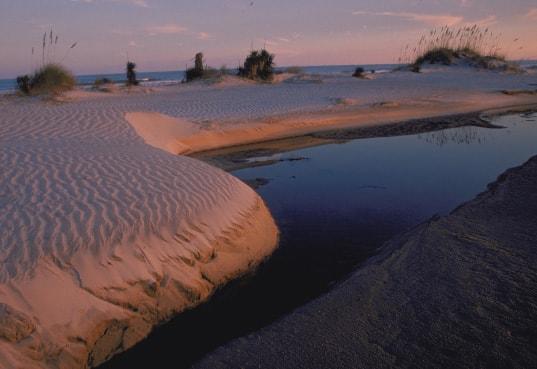
Photo credit: Georgia Department of Economic Development
Photo captions (top to bottom):
- Cumberland Island, Coastal Georgia
- Tallulah Gorge State Park, Savannah Basin
- Georgia Veterans State Park Golf, Flint Basin
- Yellow River Water Treatment Plant, Ocmulgee Basin