3.0 Georgia's Water Resources
We cannot effectively plan for and manage what we do not properly measure. Better technical information about Georgia’s water resources is necessary to ensure sustainable management. What are the capacities of our water resources?
The state’s waters support a range of uses and provide a variety of benefits. These include benefits from water withdrawn for household, commercial, industrial, and agricultural use, among others. Surface waters also provide benefits through uses that occur within the banks of streams, rivers, and lakes. These instream uses include dilution and processing of wastewater, boating, fishing, and other uses.
To improve information on the long-term capacity of Georgia’s waters to support all these uses, EPD modeled responses of water resources to a range of demands. Results were compared with thresholds that indicate unacceptable impacts. The models determined if demands for water consumption and wastewater discharge can be met without violating the thresholds. The results helped Councils identify areas where management actions will be needed to ensure long-term sustainability.
Models were developed to assess groundwater availability, surface water availability, and surface water quality. Results for current conditions were generally consistent with the observations of water users and managers in each region, demonstrating the models’ value as tools for assessment of future conditions and alternatives. Council members reviewed the results and provided input to further enhance the models’ value as assessment tools.
3.1 Groundwater Availability
Groundwater availability was evaluated by looking at the amount of groundwater that can be withdrawn from an aquifer without causing negative impacts. This amount is known as the aquifer’s sustainable yield. The negative impacts evaluated to determine sustainable yield included decreases in water levels that can affect neighboring wells and reductions in the amount of groundwater that seeps into streams and contributes to streamflow.
Results indicate that, for most of the aquifers in Georgia’s Coastal Plain, relatively large quantities of additional groundwater are available before sustainable yields are reached – with two exceptions. The first exception is the Upper Floridan aquifer in the Dougherty Plain. The second is the Upper Floridan aquifer in the Brunswick and Savannah areas, where movement of saltwater into the aquifer is a significant localized issue.
Smaller amounts of additional groundwater are also available from the Paleozoic rock aquifer in northwest Georgia and from the crystalline rock aquifer in the Piedmont and Blue Ridge, before sustainable yields are reached.
For all of the aquifers studied, the amount of water that can be sustainably withdrawn will depend, in part, on the location of new wells. Site-specific studies will be necessary to determine groundwater availability at a more detailed level.
Sustainable yields were determined by modeling differing amounts and locations for groundwater withdrawals. Determining the sustainable yield of all of the aquifers in Georgia would have been quite costly and time consuming. Studies were conducted on the most important aquifers, as indicated by the amount of water currently withdrawn and forecasts of significant increases in demand, among other characteristics.
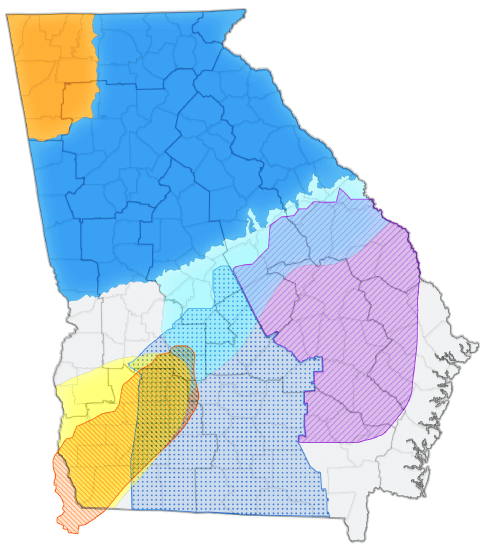
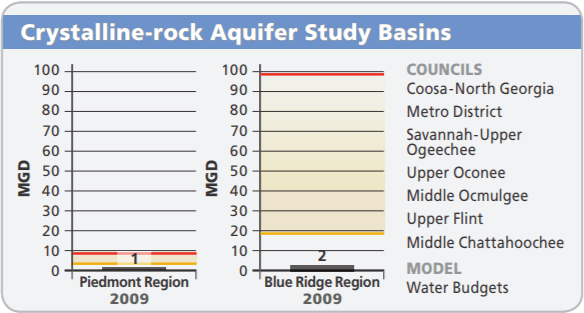
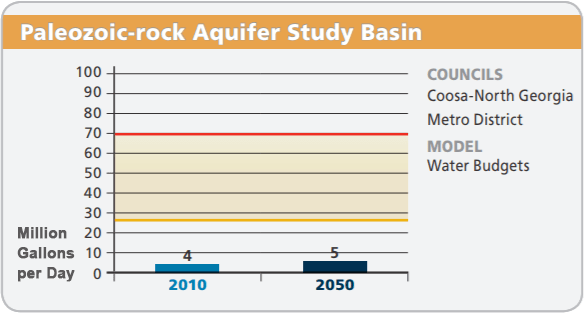
This figure show the location of each aquifer studied and the forecasted groundwater demand for 2010 and 2050 (the crystalline rock aquifer was not evaluated for these years, so results are limited to 2009).
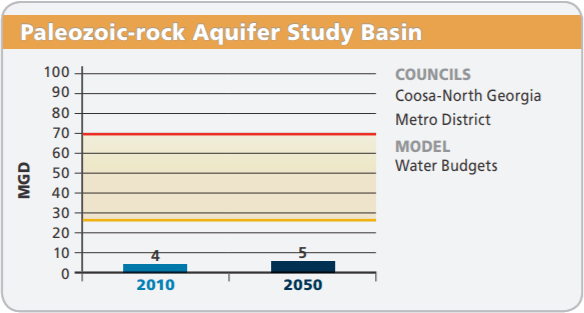
The range of sustainable yield for each aquifer is shown by the orange bar across each graph. Demand and sustainable yields are expressed in millions of gallons on an average day in a dry year (abbreviated mgd).
3.1.1 Aquifer Maps
Aquifers
Legend
Paleozoic-rock Aquifer
Crystalline-rock Aquifer
Cretaceous Aquifer in Georgia’s Coastal Plain
Claiborne Aquifer in Georgia’s Coastal Plain
South Central Georgia Floridan Aquifer Area
Dougherty Plain Upper Floridan Aquifer Area
Eastern Coastal Plain Floridan Aquifer Area
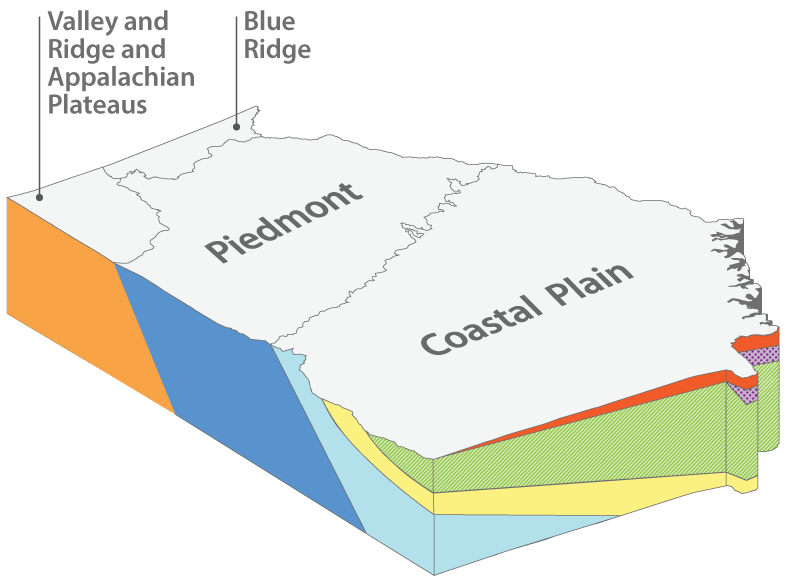
Aquifer Depth
Legend
Valley and Ridge Appalachian Plateau aquifers
Paleozoic-rock aquifer
Piedmont and Blue Ridge aquifers
Crystalline-rock aquifer
Coastal Plain aquifers
Surficial aquifer system (not principal aquifer)
Brunswick aquifer system
Floridan aquifer system
Claiborne, Clayton, and Providence aquifers
Cretaceous aquifer system
3.1.2 Groundwater Availability by Aquifer (charts)
Legend
Range of Sustainable Yield
Projected Demand with 75% Agricultural Use in 2010
Projected Demand with 75% Agricultural Use in 2050
Projected Demand in 2009
MGD: Million Gallons per Day
Paleozoic-rock Aquifer Study Basin
Councils:
- Coosa-North Georgia
- Metro District
Model: Water Budgets
Crystalline-rock Aquifer Study Basins
Councils:
- Coosa-North Georgia
- Metro District
- Savannah-Upper Ogeechee
- Upper Oconee
- Middle Ocmulgee
- Upper Flint
- Middle Chattahoochee
Model: Water Budgets
Cretaceous Aquifer in Georgia's Coastal Plain
Councils:
- Savannah-Upper Ogeechee
- Upper Oconee
- Middle Ocmulgee
- Upper Flint
- Suwannee-Satilla
- Altamaha
Model: Sustainable Yield
Claiborne Aquifer in Georgia's Coastal Plain
Councils:
- Middle Chattahoochee
- Upper Flint
- Lower Flint
- Suwannee-Satilla
Model: Sustainable Yield
Upper Floridan Aquifer: South Central Georgia and Eastern Coastal Plain
(Modeled Together)
Councils:
- Upper Oconee
- Savannah-Upper Ogeechee
- Altamaha
- Suwannee-Satilla
- Coastal
Model: Sustainable Yield
Coastal Area
The Upper Floridan aquifer along the coast was intensively studied before regional water planning began. EPD's 7-year study of coastal groundwater has shown that, in some parts of the region, availability is limited by movement of saltwater into the aquifer.
Upper Floridan Aquifer: Dougherty Plain
Councils:
- Upper Flint
- Lower Flint
- Suwannee-Satilla
Model: Sustainable Yield
Upper Floridan Aquifer: South Central Georgia
Councils:
- Upper Flint
- Lower Flint
- Suwannee-Satilla
- Middle Ocmulgee
- Altamaha
Model: Sustainable Yield
3.1.2 Groundwater Availability by Aquifer (table)
| Aquifer | Sustain-able Yield Minimum | Sustain-able Yield Maximum | Projected Demand with 75% Agricult-ural Use in 2010 | Projected Demand with 75% Agricult-ural Use in 2050 | Projected Demand in 2009 |
|---|---|---|---|---|---|
| Paleozoic-rock Aquifer Study Basin | 27 | 70 | 4 | 5 | none |
| Crystalline-rock Aquifer Study Basins (Piedmont Region) | 3 | 9 | none | none | 1 |
| Crystalline-rock Aquifer Study Basins (Blue Ridge Region) | 19 | 99 | none | none | 2 |
| Cretaceous Aquifer in Georgia's Coastal Plain | 347 | 445 | 247 | 303 | none |
| Claiborne Aquifer in Georgia's Coastal Plain | 144 | 640 | 148 | 174 | none |
| Upper Floridan Aquifer: South Central Georgia and Eastern Coastal Plain (Modeled Together) | 880 | 992 | 580 | 739 | none |
| Upper Floridan Aquifer: Dougherty Plain | 235 | 330 | 587 | 681 | none |
| Upper Floridan Aquifer: South Central Georgia | 615 | 832 | 366 | 471 | none |
Coastal Area
The Upper Floridan aquifer along the coast was intensively studied before regional water planning began. EPD's 7-year study of coastal groundwater has shown that, in some parts of the region, availability is limited by movement of saltwater into the aquifer.
3.1.2 Groundwater Availability by Aquifer (Paleozoic-rock Aquifer Study Basin)
Skip to text version of chart.
Chart
Legend
Range of Sustainable Yield
Projected Demand with 75% Agricultural Use in 2010
Projected Demand with 75% Agricultural Use in 2050
Text Version
| Year | Projected Demand with 75% Agricultural Use |
|---|---|
| 2010 | 4 million gallons per day |
| 2050 | 5 million gallons per day |
Sustainable Yield: 27-70 million gallons per day
Basin Details
Councils:
- Coosa-North Georgia
- Metro District
Model: Water Budgets